Cord ledger
Everything published so far
Every entry on the site: knots, patterns and project tracks. Scheduled entries appear on their date without any further work.
-
01
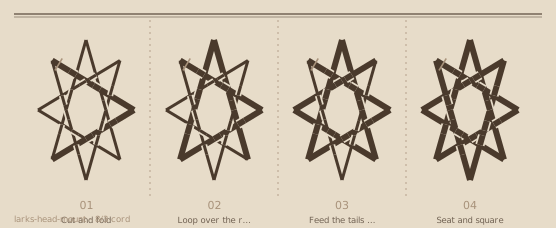
Lark's Head Mount: getting the first cord onto the rail
The mount that starts nearly every macramé piece. Two cords become four working ends in one pass, and the direction you fold the loop in decides whether your first row hangs flat or fights you for the rest of the build.
-
02
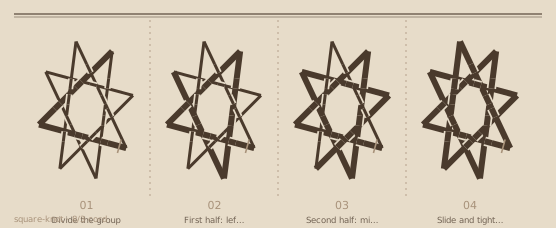
Square knot: the flat knot every pattern is built on
Two mirrored half knots stacked on a stationary core. Done right it is a flat, reversible rectangle with a small bar across the middle; done sloppily it turns into a spiral, and your wall hanging will lean.
-
03
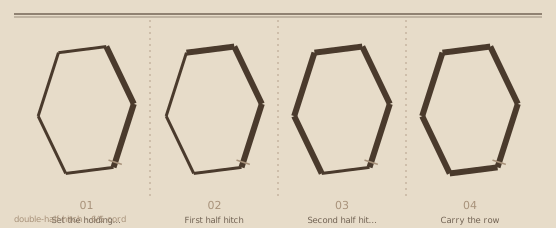
Double half hitch: drawing a line with cord
Two half hitches tied in the same direction make the one knot that can draw a straight or diagonal line anywhere in a macramé piece. It is how circles get closed, shelves get levelled and diamonds get their edges.
-
04
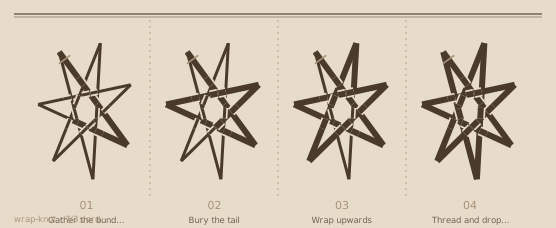
Wrap knot: the clean way to close a bundle of cords
A dense coil of cord that binds a bundle and hides its own tail. It is the knot that finishes plant hangers, gathers the fringe of a wall hanging and hides the join where two rows meet.
-
05
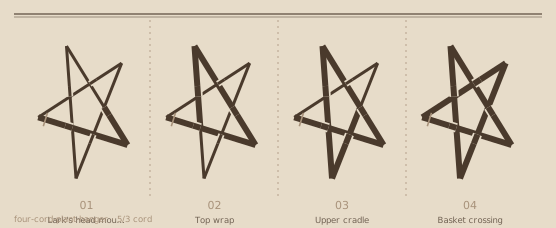
Four-cord plant hanger: the classic cradle
Four cords, three kinds of knot, one afternoon. This is the version that holds a 14 to 18 cm pot at a stable height and still looks right when the plant grows into it.
-
06
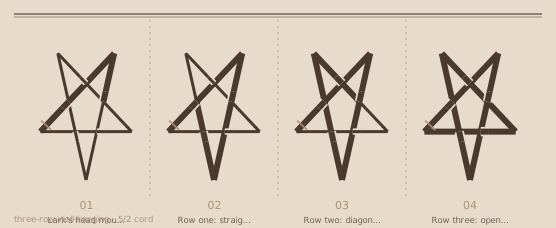
Three-row wall hanging: band, V and open panel
One dowel, three rows and three different knot families. The straight band sets the width, the diagonal V draws the eye inwards, and the open panel underneath keeps the whole piece from looking heavy.
-
07
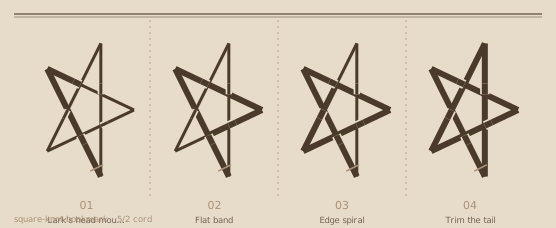
Square knot bookmark: a 45 minute flat band
Six cords, one flat band, and a fringe that does the job a tassel usually does. It is the smallest project that still uses the mount, the square knot and a spiral edge, which makes it a good test piece before a wall hanging.
-
08
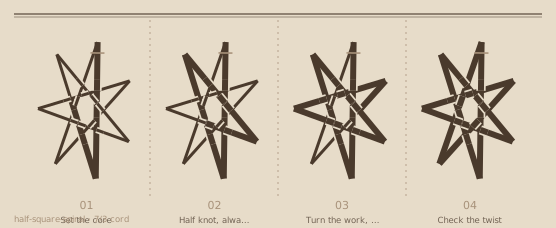
Half square knot spiral: the twisted cord look
The same two-cord movement as a square knot, but never mirrored. The result is a rope that twists itself into a spiral without any core, which is why it makes such a good stem, handle or hanging loop.
-
09
Alternating square knots: building a checkerboard panel
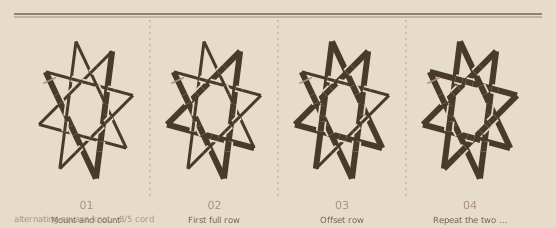
Square knots worked in overlapping groups so each row sits half a knot to the side of the one above. It is the fastest way to turn a bundle of mounted cords into a solid woven panel.
-
10
Cord-wrapped jar lantern: a 75 minute first project
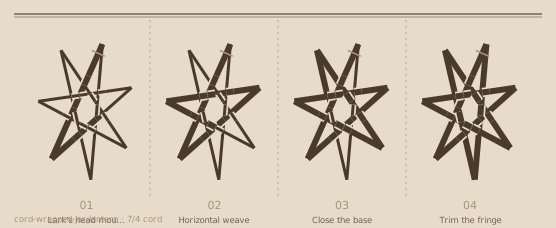
A net of vertical ribs held by five horizontal passes, closed under the base and hung from a loop. It is the cheapest way to find out how your tension behaves, because the jar inside shows you immediately when the weave is uneven.
-
11
Overhand knot chain: cord that becomes a stem
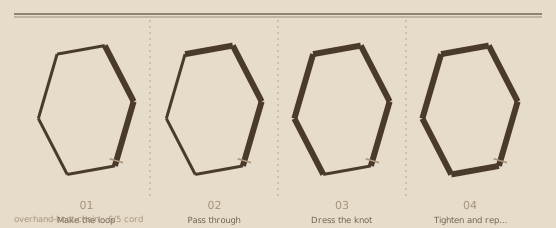
The first knot anyone learns, repeated into something useful. A chain of overhand knots makes a stiff stem for a flower, a stem for a hanging loop, and a surprisingly strong core for a tassel.
-
12
Figure-eight knot: a stop that will not jam
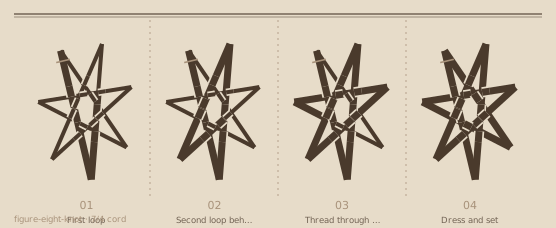
A knot that keeps roughly 75 per cent of cord strength and still unties after being loaded. In macramé it is the stop knot at the end of a cord, the anchor for a loop, and the safe alternative wherever an overhand knot would jam.
-
13
Berry knot: a bead made out of the cord itself
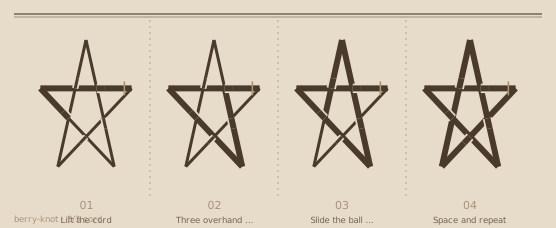
Three overhand knots worked in one loop produce a small dense ball on a single cord. It is the cheapest way to add punctuation between rows without adding beads, and it uses nothing but the cord already in your hands.
-
14
Round coaster: growing a flat circle with double half hitches
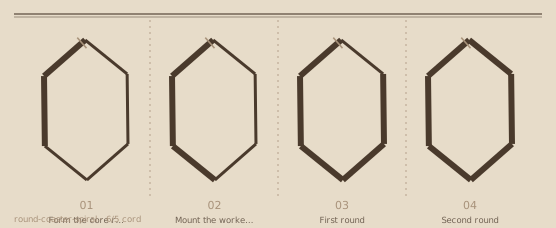
A 5 cm core ring, eight cords and three rounds of hitches that add up to a flat 14 cm disc. Nothing here is hard except keeping the circle flat, which is entirely about how many extra hitches you add per round.
-
15
Josephine knot: the rounded petal for decorative rows
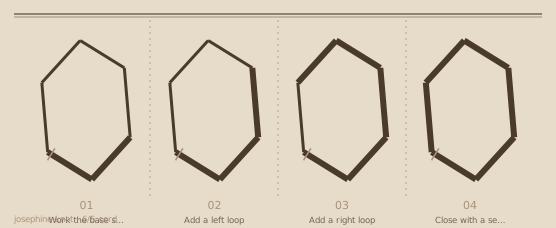
Two loops caught inside a square knot, giving a soft oval that reads as a petal or a small shell. It is the knot that turns a plain checkerboard panel into something with a motif in it.
-
16
Crown knot: closing the top of a tassel
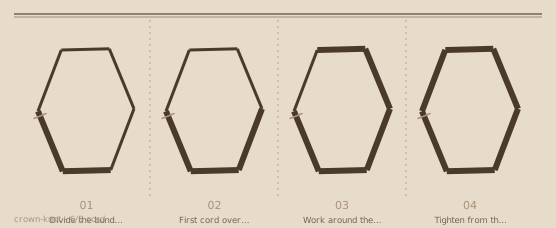
Each cord laid over the bundle and down beside its neighbour, forming a rounded cap. It is the neat way to close the end of a tassel, the top of a cord-wrapped door stop, or the base of a hanging loop.
-
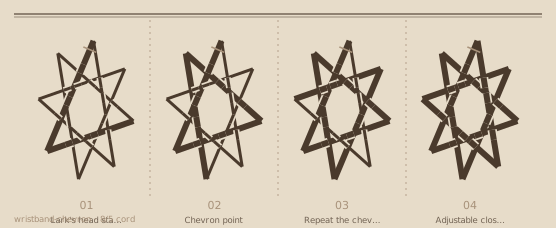
17
Chevron wristband: a flat band with a sliding closure
Six cords worked into stacked V shapes, closed with a square-knot slider that adjusts over 4 cm. It is the smallest piece where every hitch has to face the same way, so it is unforgiving and quick to read.
more entries are written and scheduled to appear over the coming weeks.