Knot · Beginner · 7 min
Overhand knot chain: cord that becomes a stem
The first knot anyone learns, repeated into something useful. A chain of overhand knots makes a stiff stem for a flower, a stem for a hanging loop, and a surprisingly strong core for a tassel.
Published 29 Sep 2026 · · 3-ply twisted cotton 4 mm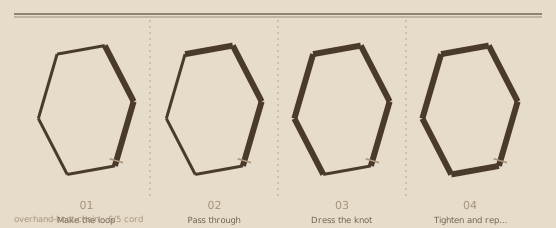
At a glance
- Kind · Knot
- Level · Beginner
- Working time · 7 min
- Cord · 3-ply twisted cotton
- Thickness · 4 mm
- Sample · a 40 cm chain of 22 overhand knots
- Finish · last knot pushed flush, tails trimmed to 6 cm
Make the loop
Cross the working end over the standing part to make a loop big enough for two fingers, about 4 cm across on a 4 mm cord.
Pass through
Bring the working end behind and up through the loop from underneath. Do not tighten yet.
Dress the knot
Work the slack around the knot so the two strands lie parallel rather than crossing inside. This is the step that decides whether the chain hangs straight.
Tighten and repeat
Pull the loop closed onto the knot above, leaving 3 mm of gap, then tie the next knot. Tightening each knot as you go keeps the spacing even.
Spacing decides the look
Tightened knot to knot, an overhand chain reads as a solid cord with ridges. Spaced 1 cm apart, the same chain reads as beads on a string and behaves like a decorative stem. Decide the spacing before you start and count in blocks of five, or the gaps will drift by the bottom of the chain. On 4 mm cord each knot costs about 3.5 cm, so a 40 cm chain of 22 knots uses roughly 77 cm.
Dressing the knot
An overhand knot pulled tight without dressing has a crossing hidden inside it and sits at a slight angle. Working the slack around before tightening makes the two strands lie parallel through the knot, which is why a dressed chain hangs dead straight while an undressed one looks hand-made in the wrong way.
Strength and the honest limits
An overhand knot reduces cord strength by roughly half because the bend is tight. That is fine for a 4 mm cotton cord with a working load of a few kilograms, but an overhand chain is not a climbing knot and should never be used as one. For load-bearing macramé, use a figure-eight or a wrap knot instead.
Where the chain earns its place
Use it as the stem inside a macramé flower, as the hanging loop at the top of a small wall piece, or as the tie that gathers a curtain panel. In all three cases the chain is doing light structural work and its ribbed texture is the point rather than a side effect.
Spaced or tight, and what it costs
The two styles are different tools. Pushed tight, a chain is stiff sideways and makes a credible stem or a keyring loop. Spaced at 1 cm, the same chain bends easily and behaves like a strung bead line, which is what you want on a hanging cord that has to take a gentle curve. Cord cost is the same either way at about 3.5 cm per knot on 4 mm cord, so a 30 cm tight chain of 22 knots and a 30 cm spaced chain of 12 knots differ by half a metre of cord. Decide which one you are making before the first knot, because converting a tight chain into a spaced one means unpicking all of it.
Where it goes wrong
- Tightening the first four knots and then rushing, so the bottom half of the chain has visibly wider gaps.
- Skipping the dressing step, which leaves every knot sitting at a small angle to the line.
- Using an overhand chain as a load-bearing loop, where its roughly 50 per cent strength loss matters.
Check before moving on
- Holding the chain up by one end, it hangs without an obvious curve to one side.
- Gaps between knots are within 1 mm of each other over the whole chain.
- The standing part shows no kinks where the knots were tightened.