Knot · Intermediate · 16 min
Alternating square knots: building a checkerboard panel
Square knots worked in overlapping groups so each row sits half a knot to the side of the one above. It is the fastest way to turn a bundle of mounted cords into a solid woven panel.
Published 23 Sep 2026 · · 3-ply twisted cotton 4 mm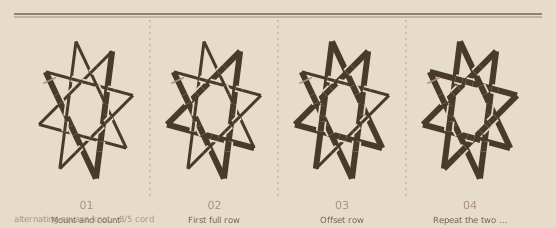
At a glance
- Kind · Knot
- Level · Intermediate
- Working time · 16 min
- Cord · 3-ply twisted cotton
- Thickness · 4 mm
- Sample · checkerboard panel 12 cm tall from 8 cords
- Finish · bottom row aligned, ends trimmed on a shallow curve
Mount and count
Eight cords give you two square knots in the first row and three in the second, because the groups overlap by one cord at each side.
First full row
Work a square knot in cords 1 to 4, then another in cords 5 to 8. Push both up to the mount and check they sit level.
Offset row
Now take cords 3 to 6 as one group and work a knot, then use the outer pairs as working cords for the knots on either side.
Repeat the two rows
Alternate full and offset rows. Six row pairs give a panel about 12 cm tall that hangs with an obvious grid.
Count your cords before you start
A checkerboard needs a cord count that is a multiple of four plus two: 6, 10, 14 or 18 cords. With 8 cords you get two knots in the full rows and three in the offset rows, which is a narrow but perfectly usable panel. With 18 cords the panel is wide enough for a cushion cover face at roughly 26 cm.
Offset rows bind the whole panel
The offset row is what stops the panel from splitting into vertical strips. Because the outer pairs are pulled inwards as working cords, the fabric closes up and the whole piece behaves as one sheet. Skip the offset rows and the panel falls apart into columns of knots with daylight between them.
Cord consumption in a dense panel
A checkerboard eats far more cord than a sparse pattern. Each square knot consumes about 5 cm of each working cord, so a 12 cm tall panel of six row pairs uses roughly 60 to 70 cm per cord, and the working cords at the edges travel even further. Multiply your finished height by 5 rather than 4 when cutting for a checkerboard.
Keeping the grid straight
The panel tells on you immediately: one row worked 5 mm too low and the whole grid looks slanted. Work each full row up against the row above, then check the width with a ruler before starting the offset row. If the panel has grown 1 cm wider over five rows, your knots are too loose and the lower half of the piece will be visibly flared.
Planning how many rows you need
A full row plus an offset row measures 2 to 2.2 cm on 4 mm cord once both are pushed tight, so a panel's height is close to 2 cm per row pair. For a 30 cm panel that is fourteen pairs, or 28 rows, which takes about 90 minutes of working time and roughly 1.5 m from each edge cord. Write the row count on paper before you start: counting pairs is far easier than counting knots, and a panel that ends mid-pair looks unfinished from three metres away.
Where it goes wrong
- Using 7 or 9 cords, which cannot produce a symmetric checkerboard.
- Leaving the offset rows out entirely, so the panel splits into columns.
- Cutting cords to the 4x rule and running out 8 cm short on a 30 cm panel.
Check before moving on
- Each offset knot sits exactly halfway between the two knots above it.
- The panel is the same width at the top and at the bottom.
- Row heights are consistent to within 3 mm.