Knot · Beginner · 9 min
Half square knot spiral: the twisted cord look
The same two-cord movement as a square knot, but never mirrored. The result is a rope that twists itself into a spiral without any core, which is why it makes such a good stem, handle or hanging loop.
Published 20 Sep 2026 · · 3-ply twisted cotton 4 mm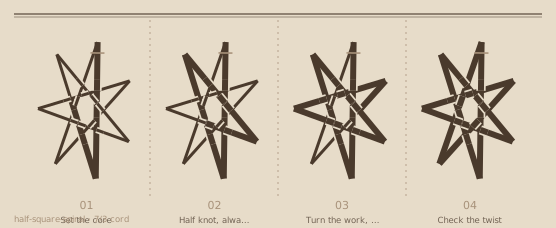
At a glance
- Kind · Knot
- Level · Beginner
- Working time · 9 min
- Cord · 3-ply twisted cotton
- Thickness · 4 mm
- Sample · 20 half knots in one direction
- Finish · spiral ends on a full turn, not mid-twist
Set the core
Keep the two middle cords separate and straight. The tighter you hold them, the more even the spiral's pitch will be.
Half knot, always the same way
Left cord over the cores and under the right cord, then the right cord up through the loop. Never mirror it, however much your hands want to.
Turn the work, not the knot
After every four or five half knots, give the piece a quarter turn so you are always working towards yourself. This keeps the pitch even.
Check the twist
A finished spiral should show a clean stair of ridges with no flat spot where you lost the direction for a knot or two.
One direction, forever
A half square knot is one half of a square knot. Repeat it in the same direction and the knot rotates a few degrees each time, producing a spiral with a pitch of roughly 8 mm per knot on a 4 mm cord. Mirror even one knot in the middle and you get a visible flat spot that no amount of pulling will remove.
How many half knots for a given length
Twenty half knots make about 16 cm of spiral, so the finished length is roughly 0.8 cm per knot. To spiral a 30 cm section you need around 38 knots, and because each knot eats about 5 cm of working cord, that single section consumes nearly 2 m per working cord.
Keeping the pitch even
Pitch drifts when your hands rotate around the work instead of turning the work itself. Turn the piece a quarter turn every four or five knots and always pull towards your own body. On a long spiral, an even pitch matters more than perfect tightness: a slightly loose but regular spiral looks deliberate, an uneven tight one looks like a mistake.
Where to stop
Stop on a complete turn so the spiral ends pointing the same way it started. Half a turn at the bottom looks like an unfinished row. If the spiral feeds into a knot row below, add one extra half knot after the last full turn so the ridge line runs straight into the row rather than ending beside it.
Spirals as handles, stems and loops
A spiral is the only knot here that adds stiffness without adding a core, which makes it the right answer for anything that has to hold a shape: the handle of a cord basket, the stem of a flower, the loop at the top of a wall piece. A 12 cm spiral of 15 half knots on two 4 mm cords holds a gentle curve under its own weight and straightens out under about 2 kg of pull, so size it about 20 per cent longer than the shape you want if the piece will ever be loaded. Worked on four cords instead of two, the same knot gives a square section rather than a rope, which reads as a ribbed stem and is worth trying on a flower where a round stem looks too soft.
Where it goes wrong
- Mirroring one knot and leaving a flat spot that stands out at arm's length.
- Holding the core cords slack, which makes the pitch wander from wide to narrow.
- Landing the last knot mid-turn, so the spiral looks cut off rather than finished.
Check before moving on
- The ridges form one continuous diagonal line from top to bottom.
- The core cords are invisible from the front throughout the spiral.
- The spiral ends on a full turn when viewed from the side.