Cord ledger
Knot dictionary
Knot entries in release order. Each one names the cord, the thickness, the tension habits that matter and the mistakes that actually happen, with a step line drawing.
-
01
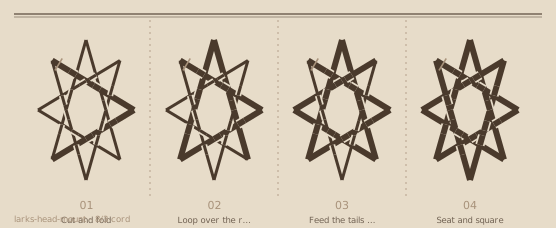
Lark's Head Mount: getting the first cord onto the rail
The mount that starts nearly every macramé piece. Two cords become four working ends in one pass, and the direction you fold the loop in decides whether your first row hangs flat or fights you for the rest of the build.
-
02
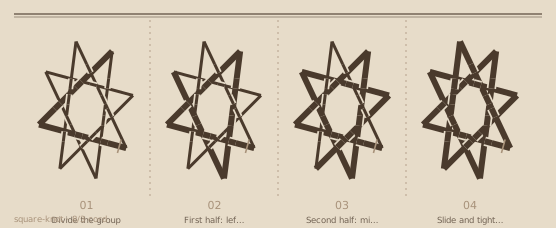
Square knot: the flat knot every pattern is built on
Two mirrored half knots stacked on a stationary core. Done right it is a flat, reversible rectangle with a small bar across the middle; done sloppily it turns into a spiral, and your wall hanging will lean.
-
03
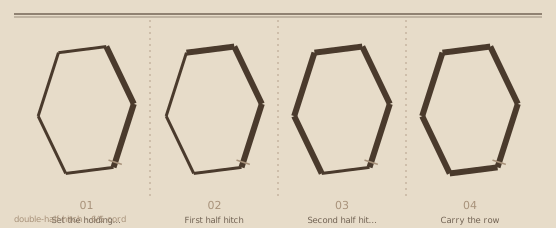
Double half hitch: drawing a line with cord
Two half hitches tied in the same direction make the one knot that can draw a straight or diagonal line anywhere in a macramé piece. It is how circles get closed, shelves get levelled and diamonds get their edges.
-
04
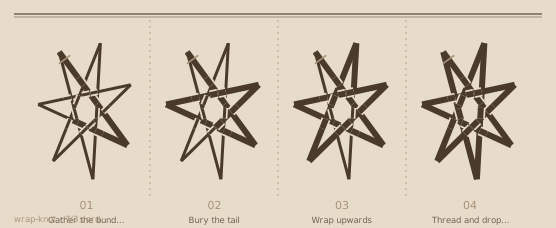
Wrap knot: the clean way to close a bundle of cords
A dense coil of cord that binds a bundle and hides its own tail. It is the knot that finishes plant hangers, gathers the fringe of a wall hanging and hides the join where two rows meet.
-
05
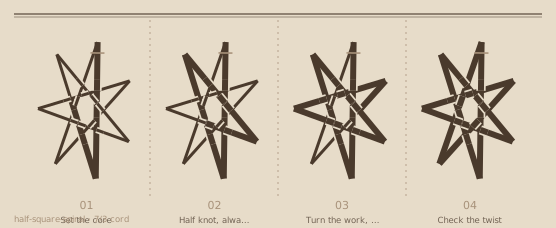
Half square knot spiral: the twisted cord look
The same two-cord movement as a square knot, but never mirrored. The result is a rope that twists itself into a spiral without any core, which is why it makes such a good stem, handle or hanging loop.
-
06
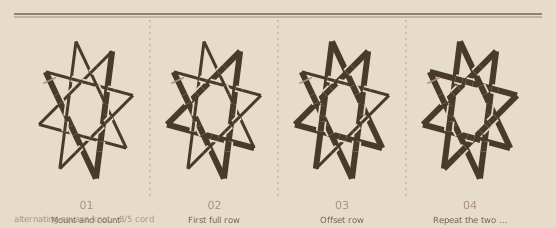
Alternating square knots: building a checkerboard panel
Square knots worked in overlapping groups so each row sits half a knot to the side of the one above. It is the fastest way to turn a bundle of mounted cords into a solid woven panel.
-
07
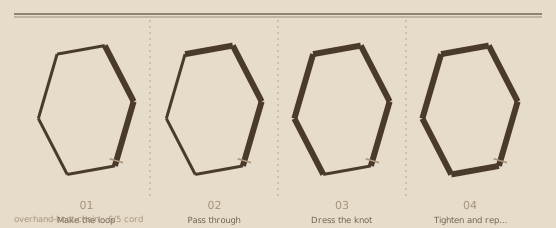
Overhand knot chain: cord that becomes a stem
The first knot anyone learns, repeated into something useful. A chain of overhand knots makes a stiff stem for a flower, a stem for a hanging loop, and a surprisingly strong core for a tassel.
-
08
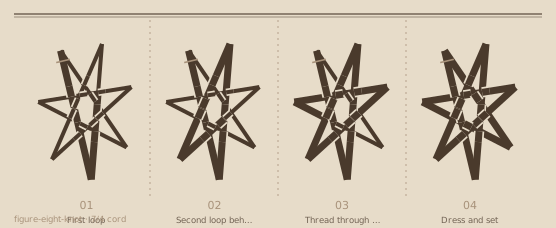
Figure-eight knot: a stop that will not jam
A knot that keeps roughly 75 per cent of cord strength and still unties after being loaded. In macramé it is the stop knot at the end of a cord, the anchor for a loop, and the safe alternative wherever an overhand knot would jam.
-
09
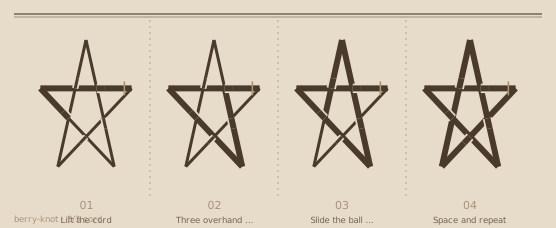
Berry knot: a bead made out of the cord itself
Three overhand knots worked in one loop produce a small dense ball on a single cord. It is the cheapest way to add punctuation between rows without adding beads, and it uses nothing but the cord already in your hands.
-
10
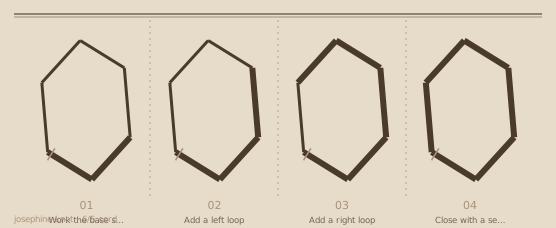
Josephine knot: the rounded petal for decorative rows
Two loops caught inside a square knot, giving a soft oval that reads as a petal or a small shell. It is the knot that turns a plain checkerboard panel into something with a motif in it.
-
11
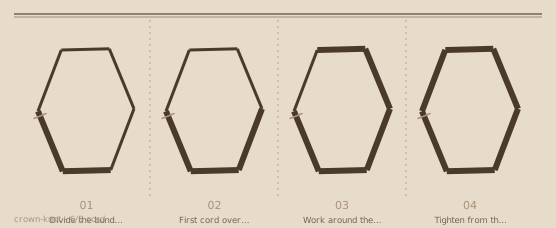
Crown knot: closing the top of a tassel
Each cord laid over the bundle and down beside its neighbour, forming a rounded cap. It is the neat way to close the end of a tassel, the top of a cord-wrapped door stop, or the base of a hanging loop.
more entries are written and scheduled to appear over the coming weeks.