Knot · Advanced · 22 min
Josephine knot: the rounded petal for decorative rows
Two loops caught inside a square knot, giving a soft oval that reads as a petal or a small shell. It is the knot that turns a plain checkerboard panel into something with a motif in it.
Published 12 Oct 2026 · · 3-ply twisted cotton 4 mm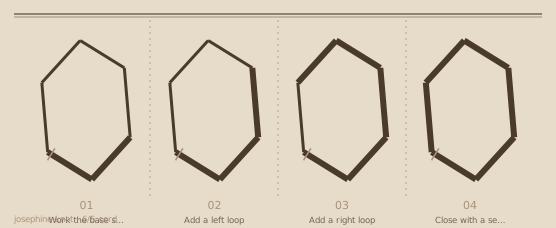
At a glance
- Kind · Knot
- Level · Advanced
- Working time · 22 min
- Cord · 3-ply twisted cotton
- Thickness · 4 mm
- Sample · a column of 4 josephine knots
- Finish · loops even, knot pushed up to the row above
Work the base square knot
Tie a normal square knot and push it up, leaving 6 cm of working cord below the knot on each side.
Add a left loop
Fold the left working cord into a 3 cm loop that lies against the core cords, with the fold pointing outwards.
Add a right loop
Fold the right working cord the same way so the two loops sit mirror-image across the cores.
Close with a second square knot
Tie a square knot below the two loops, catching both loops inside it. This closes the loops and produces the rounded petal shape.
It is three knots, not one
A josephine knot is a square knot, two folded loops, and a second square knot that closes them. Understanding that order matters: if you fold the loops before the first square knot is tightened the loops will be different sizes, and the petal will be visibly lopsided by the time you reach the bottom of a column.
Loop size controls the petal
A 3 cm loop makes a petal about 2.5 cm wide on a 4 mm cord, which fits neatly inside a four-cord group. A 4 cm loop makes a 3.5 cm petal and will start to collide with the neighbouring group, so on a standard 8-cord panel you should keep loops at 3 cm and space the josephine columns at least 6 cm apart.
Cord cost
Each josephine knot consumes about 16 cm per working cord against 5 cm for a plain square knot, because the loops use cord without adding length. A column of four josephines on a 30 cm hanging therefore takes around 64 cm of each working cord, which is the reason josephine work is usually reserved for a feature panel rather than a whole piece.
Making the column hang straight
Rotate the piece slightly after every josephine rather than working four in a row from one side. Because the second square knot tends to pull the loops towards the side you finish on, a column worked from one side only will lean about 5 degrees by the fourth knot, which is very obvious on a hanging piece.
Where it goes wrong
- Folding the loops before the base square knot is pushed up, so the petal sits too low and collides with the next one.
- Making the left loop larger than the right, which is invisible on the first knot and glaring by the fourth.
- Working a whole wall hanging in josephine knots and running out of cord halfway down.
Check before moving on
- Both loops are the same size within 2 mm.
- The closing square knot grips both loops, with no loop slipping out at the sides.
- A column of four knots hangs without a sideways lean.