Knot · Intermediate · 13 min
Crown knot: closing the top of a tassel
Each cord laid over the bundle and down beside its neighbour, forming a rounded cap. It is the neat way to close the end of a tassel, the top of a cord-wrapped door stop, or the base of a hanging loop.
Published 16 Oct 2026 · · 3-ply twisted cotton 4 mm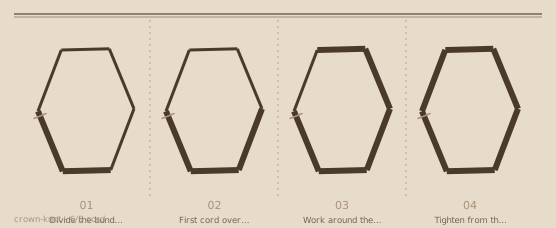
At a glance
- Kind · Knot
- Level · Intermediate
- Working time · 13 min
- Cord · 3-ply twisted cotton
- Thickness · 4 mm
- Sample · a six-cord crown closing a tassel
- Finish · crown tightened, then a 2 cm wrap beneath it
Divide the bundle in half
With six cords, hold them as three and three. Alternate the cords so both groups contain a mix of inner and outer cords.
First cord over, under
Take the first cord of group A over the top of the bundle and lay it down beside the first cord of group B, about 4 cm below the top.
Work around the crown
Repeat with each cord in turn, always laying the cord over the bundle and down beside the next cord, until you are back at the start.
Tighten from the bottom
Pull each cord downwards in turn, going round the crown two or three times rather than tightening one cord all the way first.
It only works on an even bundle
The crown relies on cords alternating over the top and down the side, so an odd number leaves one cord with nowhere to go and the cap will not close. Four, six or eight cords all work; six is the standard for a tassel because four leaves a hole in the middle and eight makes the cap too bulky for a 4 mm cord.
Tighten gradually, going round
Tightening one cord all the way before moving to the next is what makes a crown lumpy and off-centre. Go around the crown two or three times, taking each cord a little tighter, and the cap will pull down evenly. On a 4 mm cord the finished crown is about 2 cm tall and 1.5 cm across a six-cord bundle.
Combining crown and wrap
The standard tassel finish is a crown at the top of the fringe and a 2 cm wrap 1 cm below it. The crown caps the bundle, the wrap holds it, and the space between the two is where the bundle relaxes into a soft shoulder. Skipping the crown gives a flat, cut-off looking tassel; skipping the wrap makes the crown carry all the load and it will work loose.
Undoing a crown
If the cap comes out uneven, undo it rather than tightening your way out of trouble. A crown loosens easily when unloaded, so take the cords out one at a time from the last one you laid down, straighten them, and start again. Fifteen minutes spent redoing a crown beats a tassel that is permanently 8 mm off centre.
Crown, wrap or both: choosing the finish
Three finishes cover most ends and they are not interchangeable. A crown alone suits a thick bundle that has to stay open, such as the top of a tassel that will be brushed out. A wrap alone is right for a bundle that has to stay flat and tight, such as the base of a plant hanger. Crown plus wrap is the durable option and the one to use wherever the end will be handled: the crown takes the cord ends out of the way, the wrap below it carries the load, and a 2 cm wrap on a 5 mm cord holds about 8 kg without moving. Budget about 12 cm of cord for a six cord crown and another 30 cm for the wrap, and cut the cords 8 cm longer than the finished tassel so both finishes have something to work with.
Where it goes wrong
- Trying a crown on five or seven cords, where one cord is always left over.
- Tightening the first cord fully, which drags the cap to one side permanently.
- Leaving the crown without a wrap below it, so it takes the full weight of the fringe and loosens.
Check before moving on
- The cap is centred over the bundle when viewed from the end.
- All cords emerge from the cap at the same height.
- The bundle below the crown is still round rather than flattened on one side.