Knot · Beginner · 10 min
Square knot: the flat knot every pattern is built on
Two mirrored half knots stacked on a stationary core. Done right it is a flat, reversible rectangle with a small bar across the middle; done sloppily it turns into a spiral, and your wall hanging will lean.
Published 30 Aug 2026 · · 3-ply twisted cotton 4 mm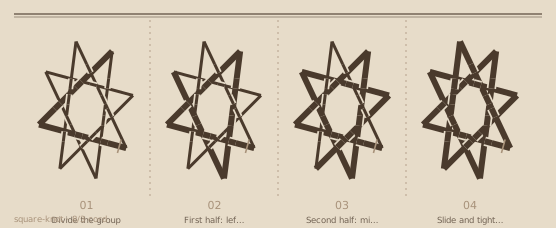
At a glance
- Kind · Knot
- Level · Beginner
- Working time · 10 min
- Cord · 3-ply twisted cotton
- Thickness · 4 mm
- Sample · 6 square knots on a 4-cord group
- Finish · last knot tightened, core cords re-straightened
Divide the group
With four cords hanging, the two inner cords stay still as the core and the two outer cords do all the travelling.
First half: left over right
Take the left cord over the two core cords, then under the right working cord. Bring the right cord under the cores and up through the loop the left cord made.
Second half: mirror it
Now the right cord goes over the cores and under the left cord, and the left cord comes up through the new loop. This mirroring is what makes the knot flat and square.
Slide and tighten
Push the finished knot up against the previous one while holding the two core cords taut, then pull the working ends outwards, not downwards.
The four-cord group
A square knot always eats four cords: two core cords that never move and two working cords that cross over them. In a 4 mm cotton cord, one finished square knot is about 12 mm tall and 18 mm wide. A row of six covers roughly 11 cm of width, which is the number to plan a wall hanging around.
Straight Vs spiral
The difference between a straight row and an accidental spiral is only whether you mirror the second half. Two left-facing halves stacked six times give a half-square spiral. Alternating left-right halves give a flat row with a visible horizontal bar in the middle of each knot. Both are correct knots; only one of them is the one your pattern asked for.
Tension: the part nobody teaches
Knots will not slide on cotton the way they slide on nylon, so a loose square knot stays loose forever. Tighten each knot to the same point on the cord: pull the two working ends outwards until the knot face is a crisp rectangle with no daylight between the two halves. If you can slide a fingernail under either half, it is not tight enough.
Spacing rows
Rows are usually spaced at 1.5 to 2 times the knot height, so about 2 cm for a 4 mm cord. Spacing two rows 3 cm apart instead gives an airy, open piece; spacing them at 1 cm gives a dense panel that uses 30 per cent more cord than you planned.
Where it goes wrong
- Forgetting to mirror the second half, which quietly turns a straight band into a spiral.
- Letting the core cords spread apart, which makes the knot wide and flat rather than square.
- Pulling the working ends downwards; this tips the knot and loosens the row above.
Check before moving on
- The knot face is a rectangle with no gap between the top and bottom halves.
- Core cords emerge straight from the bottom of the knot, not crossed.
- Six knots in a row sit at a consistent height within 2 mm.