Knot · Beginner · 6 min
Lark's Head Mount: getting the first cord onto the rail
The mount that starts nearly every macramé piece. Two cords become four working ends in one pass, and the direction you fold the loop in decides whether your first row hangs flat or fights you for the rest of the build.
Published 27 Aug 2026 · · 3-ply twisted cotton 4 mm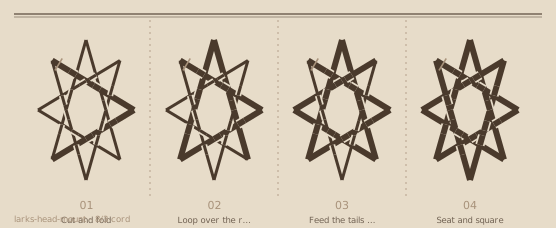
At a glance
- Kind · Knot
- Level · Beginner
- Working time · 6 min
- Cord · 3-ply twisted cotton
- Thickness · 4 mm
- Sample · 4 cords mounted on a 30 cm dowel
- Finish · even tail length, mount seated to the rail
Cut and fold
Cut four cords at 240 cm and fold each at the midpoint. The fold is the loop; the two loose halves are the working ends.
Loop over the rail
Lay the first folded cord over the dowel with the loop facing you and the two tails behind.
Feed the tails through
Bring both tails forward through the loop in one pass. Repeat for the remaining three cords, keeping 2 cm between mounts.
Seat and square
Pull each pair down together so the loop closes flat against the dowel, then line up all eight tails on a ruler edge.
Why the mount matters more than it looks
A lark's head mount is nothing but a folded cord passed through itself, yet it sets the geometry of everything above it. Because the mount is a loop and not a knot, it cannot slide tight: your first row of square knots can only be as straight as the mounts underneath it. On a 30 cm dowel, four mounts spaced 2 cm apart give you roughly 20 cm of usable width after the outer cords relax.
Choosing cord length before you fold anything
Working cord is consumed about four times faster than the pattern grows, so a wall hanging that finishes at 60 cm tall eats close to 240 cm per strand. A safe rule for a first project: cut each cord 4.5 times the finished height of the piece and add 20 cm for the tail. Cutting four cords at 240 cm covers a 50 cm hanging with room to trim later.
Seating the mount so it never sags
Hold both tails in one hand and pull straight down, not outwards. Pulling at an angle rolls the loop and leaves a visible twist in the first knot row. With a 4 mm cotton cord on a 12 mm dowel the loop should close until the two halves touch, and no further: a mount squeezed too hard compresses the dowel-side fibres and the cord will not lie flat again.
Mounting on a ring instead of a dowel
Rings take the same mount but reward a slightly different habit: mount the first cord at the top of the ring and work symmetrically downwards in both directions, so the ring stays balanced. Six cords at 2 cm spacing around a 20 cm ring leave a 2.5 cm gap at the bottom, which is the natural place for the gathering knot that closes the piece.
Where it goes wrong
- Folding the cord off-centre, so one working end is 15 cm shorter and runs out two rows before the other.
- Pulling the two tails separately; the loop rolls and the mount sits at an angle.
- Spacing the mounts by eye and ending up with a row that is 3 cm wider on one side.
Check before moving on
- All loops sit flat against the dowel with no visible twist when viewed from the front.
- Every tail pair is the same length within 5 mm.
- The mounted row is level when the dowel is held up at one end.