Knot · Intermediate · 11 min
Figure-eight knot: a stop that will not jam
A knot that keeps roughly 75 per cent of cord strength and still unties after being loaded. In macramé it is the stop knot at the end of a cord, the anchor for a loop, and the safe alternative wherever an overhand knot would jam.
Published 2 Oct 2026 · · braided cotton or polyester blend 5 mm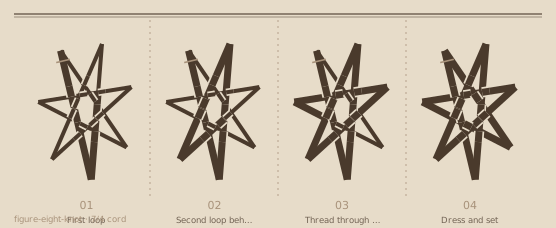
At a glance
- Kind · Knot
- Level · Intermediate
- Working time · 11 min
- Cord · braided cotton or polyester blend
- Thickness · 5 mm
- Sample · a loop stop on a 5 mm cord
- Finish · knot dressed and set, tail 10 cm
First loop
Cross the working end over the standing part to make a loop, keeping the crossing about 12 cm from the end.
Second loop behind
Cross the working end back over again, so the two loops sit side by side like the top of the numeral eight.
Thread through both
Bring the working end through the first loop from behind, then through the second, following the strand that is already there.
Dress and set
Pull the four strands so the knot forms a tidy eight, then tighten hard. Set it by loading the cord once to about 20 kg of pull.
Why not just an overhand knot
An overhand knot is smaller and faster, but after a real load it welds itself shut and the cord has to be cut. On a 5 mm cotton cord loaded to 20 kg, an overhand knot can take several minutes to pick apart, and the cord inside is permanently flattened. The figure-eight holds about 75 per cent of the cord's strength against the overhand's 50 per cent and still comes undone.
Getting the eight shape right
The whole knot is decided in the dressing. If the two loops are not side by side and the working strand does not follow the standing strand exactly, the knot rolls under load and takes an ugly diagonal shape. Before you tighten, look at the front of the knot: it should read as a clean eight with a single strand crossing the middle.
The macramé uses
Practical uses in macramé are mostly about stops: the end of a drawstring, the anchor above a set of hanging cords, or the loop at the top of a small piece where the wrap knot would be too bulky. Where the cord is synthetic, a figure-eight also gives a much cleaner cut end than melting the tip.
Setting the knot
A dressed figure-eight that has never been loaded will creep the first time it is used. Load the cord once to about 20 kg, or for smaller work pull firmly with both hands until the knot stops moving. After that the knot is stable and the tail can be trimmed to 10 cm.
Tying it in a bight, and on which cords
A figure-eight tied in a bight, doubling the cord through the knot, makes a fixed loop that will not slip and is the tidy way to make the top of a hanging cord. On 5 mm three-ply cotton the doubled knot measures about 3 cm and takes roughly 22 cm of cord; on braided cord of the same thickness it runs about 15 per cent smaller and holds better, which matters if the loop will be loaded and unloaded often. Avoid polypropylene entirely for this knot: it is stiff enough that a figure-eight will not seat, and it creeps under any sustained load.
Where it goes wrong
- Tightening before dressing, which freezes a rolled knot that cannot be corrected.
- Cutting the tail to 2 cm, leaving nothing to grip when the knot has to come undone.
- Using it on slippery polypropylene cord, where any loop knot creeps regardless of dressing.
Check before moving on
- The front of the knot reads as two clear loops with one strand through the middle.
- Loading the cord does not make the knot roll or change shape.
- The knot still unties by hand after being loaded once.