Pattern · Intermediate · 210 min
Three-row wall hanging: band, V and open panel
One dowel, three rows and three different knot families. The straight band sets the width, the diagonal V draws the eye inwards, and the open panel underneath keeps the whole piece from looking heavy.
Published 13 Sep 2026 · · 3-ply twisted cotton 4 mm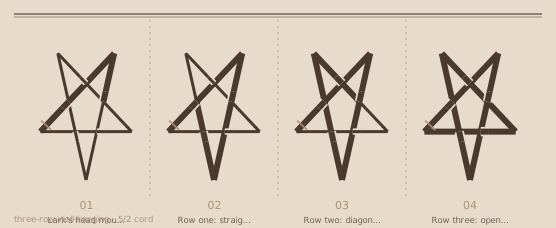
At a glance
- Kind · Pattern
- Level · Intermediate
- Working time · 210 min
- Cord · 3-ply twisted cotton
- Thickness · 4 mm
- Finished size · 38 × 62 cm
- Sample · one wall hanging on a 40 cm dowel
| Piece | Length | Qty | Note |
|---|---|---|---|
| Working cords | 220 cm | 12 | |
| Holding cord for diagonals | 120 cm | 2 | |
| Dowel | — | 1 | 40 cm, 12 mm birch |
Lark's head mount
Mount twelve 220 cm cords on the dowel at 2.5 cm spacing, giving 24 working ends. Knot: Lark's Head Mount
Row one: straight band
Work six square knots five knots deep, starting 8 cm below the dowel. Knot: Square knot
Row two: diagonal V
Using the two holding cords, work 24 double half hitches from the outer edge towards the centre on each side to form the V. Knot: Double half hitch
Row three: open panel
Below the point of the V, work eleven alternating square knots in offset rows to close the hanging.
Trim the fringe
Trim all 24 ends on a shallow curve, cutting 12 cm below the last row at the centre and 9 cm at the edges.
Plan the width from the dowel
Twelve mounts at 2.5 cm spacing fill a 40 cm dowel with 5 cm of bare wood at each end. That produces a hanging 38 cm wide when the outer cords relax. If you want a fuller 45 cm piece, mount fourteen cords on a 48 cm dowel: stay at 2.5 to 3 cm spacing, because mounts closer than 2 cm make the first row of square knots crowd into an unreadable mass.
Cutting for four rows of work
Each cord has to travel through six square knots in row one, a diagonal in row two and eleven offsets in row three. Working cords in row three travel roughly twice the hanging's height, which is why the cut is 220 cm for a 62 cm piece, not the 150 cm the 4x rule suggests. That extra 70 cm is the difference between a finished fringe and a hanging that stops 15 cm short.
Getting the V point centred
Mark the centre two cords before you start the diagonals. Work the left diagonal from the outer edge downwards, one double half hitch unit every 8 mm along the holding cord, until you reach the marked center. Then mirror the right side to the same point. Working both sides from the outside in means any measurement error lands in the middle where the V point covers it, rather than at the edges where it shows.
Finishing and hanging
A wall hanging of this size needs a dowel, not a dowel-and-string: hang it from two points 15 cm apart with a loop of cord so the dowel does not bow over time. Trim the fringe last and trim it on the wall rather than on a table, because cotton fringe moves a centimetre or so once it is hanging under its own weight.
Where it goes wrong
- Cutting to the 4x rule instead of measuring the actual row count, which leaves the fringe too short to trim.
- Starting the diagonals from the centre outwards, which puts any mismatch at the outer edges where it is most visible.
- Hanging from a single centre loop, so the 40 cm dowel bows and the whole piece sags in the middle.
Check before moving on
- The V point is centred on the dowel within 5 mm.
- Row one is the same height at both ends.
- The fringe forms a smooth curve with no steps between neighbouring cords.