Pattern · Intermediate · 120 min
Round coaster: growing a flat circle with double half hitches
A 5 cm core ring, eight cords and three rounds of hitches that add up to a flat 14 cm disc. Nothing here is hard except keeping the circle flat, which is entirely about how many extra hitches you add per round.
Published 9 Oct 2026 · · 3-ply twisted cotton 4 mm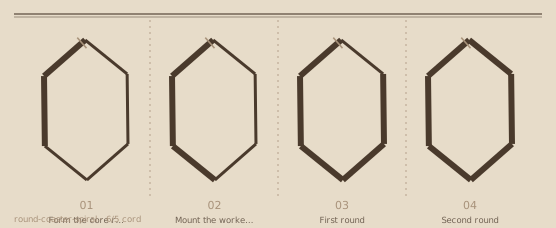
At a glance
- Kind · Pattern
- Level · Intermediate
- Working time · 120 min
- Cord · 3-ply twisted cotton
- Thickness · 4 mm
- Finished size · 14 × 14 cm
- Sample · one coaster, 14 cm across
| Piece | Length | Qty | Note |
|---|---|---|---|
| Working cords | 150 cm | 8 | |
| Core ring cord | 40 cm | 1 |
Form the core ring
Fold the 40 cm cord into a 5 cm circle and overlap the ends by 4 cm. This ring is the core every hitch wraps around.
Mount the workers
Mount the eight 150 cm cords evenly around the ring with lark's head mounts, giving sixteen working ends. Knot: Lark's Head Mount
First round
Work 18 double half hitches around the ring, covering the core completely. Knot: Double half hitch
Second round
Work the next round onto the back of the first, adding one extra hitch every six units so the circle grows without cupping.
Third round
Work 30 hitches for the outer round, then bind the sixteen ends into four bundles with 2 cm wraps. Knot: Wrap knot
The maths of a flat circle
A circle that grows in rounds needs its circumference to increase by about 2 pi times the growth in radius. Working with 4 mm cord, each round adds 1.5 cm of radius, so each round needs roughly nine more hitches than the one inside it. That is why 18, 24 and 30 works and 18, 20 and 22 does not: too few extras and the coaster cups upwards into a bowl.
Working onto the back
The second and third rounds are worked into the back of the round below, not the front. This keeps the front face smooth and means the lacy reverse side is hidden. Turn the work over after each round and check it on a flat table: if the coaster rocks, the round you just finished is too tight and needs one or two more hitches before you go further.
Cord consumption
The three rounds use about 72 hitches, each consuming roughly 6 cm of working cord on a 4 mm cord. That is 430 cm spread over sixteen working ends, or about 27 cm per end, which is why 150 cm cords leave plenty of spare at the end. Cut them at 120 cm if you plan to trim the bundles short.
Finishing so it stays flat
After the last round, press the coaster under a heavy book for a night before trimming. Cotton takes a set from pressure, and a coaster pressed flat stays flat through washing. Trim the four bundles to 2 cm and unravel the tips, or wrap them and leave 4 cm of fringe if you want the coaster to double as a trivet for a small pot.
Where it goes wrong
- Adding too few hitches in the outer rounds, so the coaster cups into a shallow bowl.
- Working all three rounds on the front face, which leaves ridges showing on the top.
- Trimming the bundles before the piece has been pressed, so the ends spring out of line later.
Check before moving on
- The coaster lies dead flat on a table with no rocking.
- The three rounds are at even radial distance from each other.
- The core ring is completely hidden by the first round.