Pattern · Intermediate · 70 min
Chevron wristband: a flat band with a sliding closure
Six cords worked into stacked V shapes, closed with a square-knot slider that adjusts over 4 cm. It is the smallest piece where every hitch has to face the same way, so it is unforgiving and quick to read.
Published 19 Oct 2026 · · braided cotton, firm twist 3 mm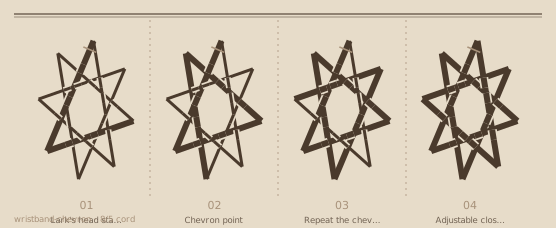
At a glance
- Kind · Pattern
- Level · Intermediate
- Working time · 70 min
- Cord · braided cotton, firm twist
- Thickness · 3 mm
- Finished size · 3 × 17 cm
- Sample · one adjustable wristband
| Piece | Length | Qty | Note |
|---|---|---|---|
| Working cords | 110 cm | 6 | |
| Closure cords | 60 cm | 2 |
Lark's head start
Mount all six cords on the first closure cord, then fold the closure cord so the mounts sit in the middle of the band. Knot: Lark's Head Mount
Chevron point
Work twelve double half hitches from the left edge to the centre, then twelve from the right edge to the centre to form the chevron. Knot: Double half hitch
Repeat the chevrons
Stack nine chevrons, each 8 mm below the one above, keeping the point aligned down the centre line.
Adjustable closure
Bring the two ends together and work six square knots over them with the second closure cord to make a sliding knot. Knot: Square knot
Chevron width and cord count
Each chevron draws one cord in from each edge, so the band narrows as it goes and then widens again on the next row. Six cords on 3 mm cotton give a 3 cm band with a chevron 2 cm wide; eight cords give a 4 cm band and a more pronounced point. Beyond eight cords the chevrons flatten out and the shape stops reading.
Why firm twist matters
A soft, loose cotton cord fuzzes and the chevron ridges blur together after a few days of wear. Look for a braided cord or a firmly twisted 3 mm cotton: it holds the ridge line and the band survives being taken off and on. Soft cord also stretches 5 to 8 per cent in wear, which is why a loose band that fits perfectly on day one is too big by the end of the month.
The sliding closure
The closure is a square-knot tube worked over the two band ends with a separate 60 cm cord. Six square knots give a 4 cm range of adjustment, which covers wrist sizes from about 15 to 19 cm. Tie it on the band, not on a spare dowel: the tube takes the shape of whatever is inside it, and a tube made on a dowel will always feel slightly loose on the band.
Wearing and washing
Cotton wristbands stretch with water. Wash by hand in cool water, press flat between two towels, and let the band dry flat rather than hanging it wet, which lengthens it by about 1 cm. If you wear it daily, expect to tighten the slider half a centimetre after the first wash and then no further.
Where it goes wrong
- Working the left half of the chevron right-facing and the right half left-facing, which opens a gap at the point.
- Using soft cord, so the ridges blur and the band stretches beyond the slider's range.
- Tying the sliding closure on a dowel rather than on the band itself.
Check before moving on
- The chevron points line up exactly down the centre of the band.
- The slider moves with firm hand pressure and does not slide on its own.
- The band is the same width at the closure and at the middle.